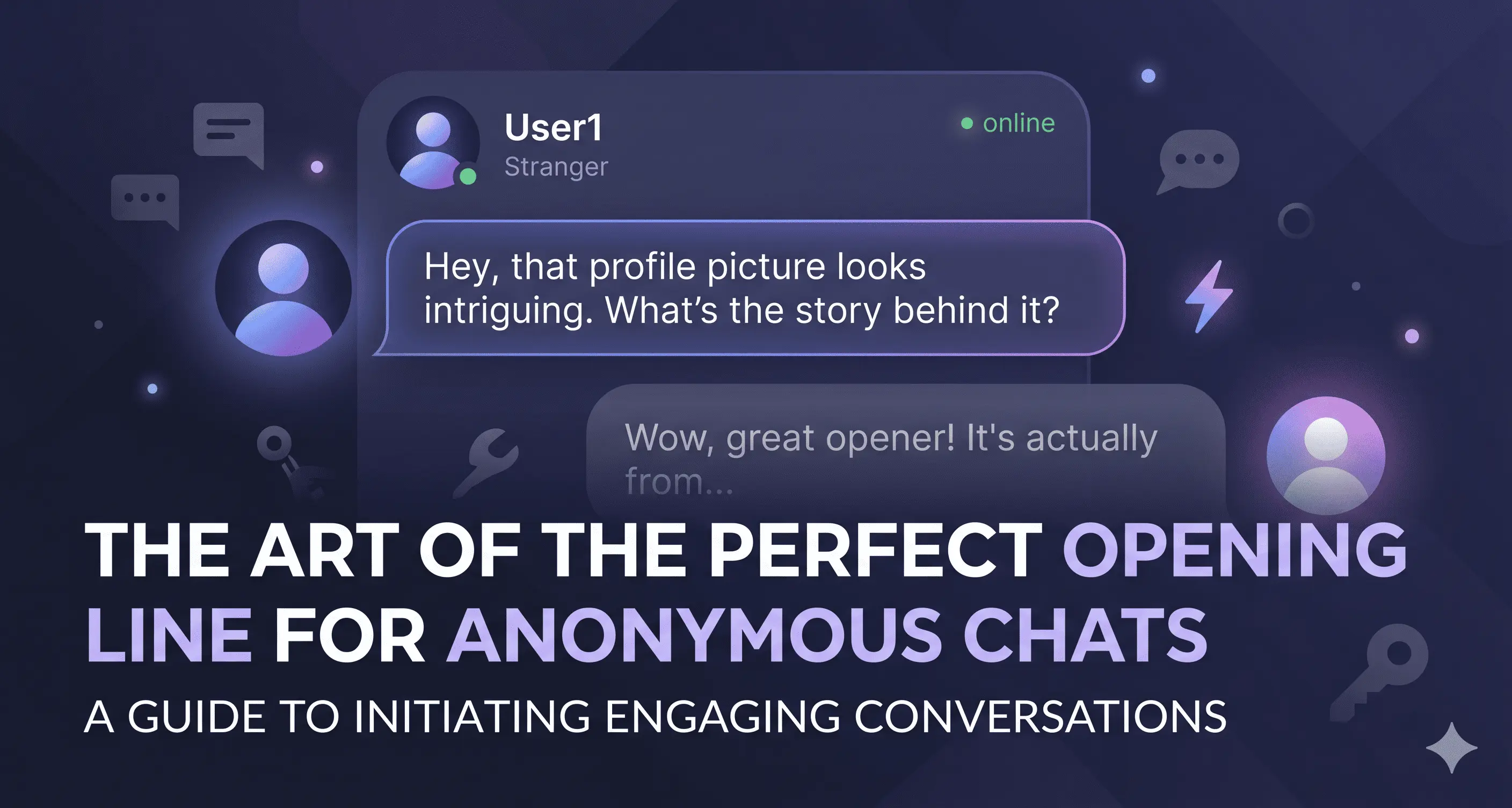
The blinking cursor on a blank screen. A digital realm where identities are hidden, avatars are generic, and the person on the other side of the connection could be absolutely anyone in the world. Welcome to the thrilling, unpredictable world of anonymous chatting.
Whether you are looking to make a new friend, kill some time, find a spark of romance, or simply engage in a deep conversation without the baggage of your real-world identity, anonymous chat platforms offer a unique sense of freedom. However, this freedom comes with a significant challenge: the attention span of your chat partner is incredibly short. In a space where the "Next" or "Skip" button is always just a click away, your very first message determines whether a meaningful connection is forged or if you are instantly relegated to the digital void.
Mastering the art of the perfect opening line for anonymous chats is not just about being witty; it is about understanding human psychology, leveraging the unique dynamics of anonymity, and creating an immediate hook that compels a stranger to type back.
Why the First Message Matters More in Anonymous Chats
In traditional online interactions—such as on social media platforms or mainstream dating apps—you have a wealth of context to fall back on. You have profile pictures, bios, mutual friends, and location tags. If your opening line is a little weak, the other person might still respond because they liked your photo or noticed you both share a hobby.
In an anonymous chat, you are stripped of all these luxuries. You have no face, no name, and no background. You are entirely defined by the words you type. Text is your only currency. Furthermore, the barrier to exit in an anonymous chat is virtually nonexistent. If someone feels even slightly bored or uninspired by your opener, there is no social pressure keeping them in the conversation. They will simply disconnect and move on to the next stranger. Therefore, your opening line must accomplish three critical tasks within seconds:
Grab attention immediately.
Establish a distinct tone or vibe.
Demand a response by making it easy and fun to reply.
The Psychology Behind a Great Conversation Starter
To craft the perfect opener, it helps to understand the "Online Disinhibition Effect." When people are anonymous, they tend to behave differently than they do in face-to-face interactions. They are often more open, more vulnerable, and more willing to engage in unconventional topics because the fear of real-world judgment is removed.
You can leverage this psychological state by bypassing the mundane small talk that plagues everyday life. A great anonymous opener taps into one of three psychological triggers:
The Curiosity Gap: Presenting a question or statement that makes the brain naturally want to seek the answer or resolution.
The Humor Response: Laughter breaks down defensive walls. If you can make a stranger smile at their screen, you have already won their trust.
The Ego Stroke or Opinion Solicitation: People love talking about themselves and sharing their opinions. Asking for a subjective take on a topic makes the other person feel valued instantly.
5 Types of Perfect Opening Lines for Anonymous Chats
Depending on the mood you want to set, there are several distinct strategies you can employ when generating your opening lines. Here are five highly effective categories, complete with examples and reasons why they work.
1. The Intriguing Question (The Curiosity Gap)
Instead of asking how they are doing, ask a question that requires a bit of imagination. This immediately pulls the other person out of their mundane reality and into a hypothetical scenario where they get to be creative.
Example 1: "If you had to disappear tomorrow and start a new life in a new country, where are you going and what is your new job?"
Example 2: "You have a time machine, but it only goes back in time and you can only stay for one hour. Where and when are you going?"
Example 3: "What is a topic you could easily give a 30-minute TED Talk on with zero preparation?"
Why it works: These questions are fun to answer. They require a bit of thought but aren't overly intrusive. They also provide you with a massive amount of material for follow-up questions. If they say they would disappear to Italy to become a baker, you instantly know they value peace, good food, and perhaps a slower pace of life.
2. The Playful Icebreaker (Humor and Absurdity)
Humor is a universal language. An absurd or overly dramatic opening line can cut through the monotony of the platform and show that you do not take yourself too seriously.
Example 1: "Settle a highly aggressive debate for me right now: does pineapple belong on pizza, or is it an absolute crime against humanity?"
Example 2: "I need an alibi. Tell me, where were we last night between the hours of 8 PM and midnight?"
Example 3: "Quick! The zombie apocalypse just started and you can only grab the object immediately to your left to defend yourself. What are we working with?"
Why it works: It forces a playful roleplay scenario from the very first second. The "zombie apocalypse" opener, for instance, often results in hilarious answers (e.g., "I guess I'm fighting off zombies with a half-empty coffee mug"). It sets a lighthearted, comedic tone for the rest of the chat.
3. The Bold Statement (Sparking Friendly Debate)
Polarizing (but non-offensive) statements are fantastic for generating immediate engagement. Human beings have a natural urge to correct people or share their contrasting opinions.
Example 1: "Hot take: Die Hard is a Christmas movie, and anyone who disagrees is just lying to themselves."
Example 2: "Aliens are definitely real, and I'm convinced they live in the deep ocean, not in space. Change my mind."
Example 3: "Coffee is actually terrible and we only drink it because society brainwashed us. What do you think?"
Why it works: It establishes confidence. You are putting a strong opinion out there and inviting them to challenge you. Even if they completely disagree, they will be compelled to tell you exactly why you are wrong, which instantly sparks a vibrant, energetic conversation.
4. The Situation-Based Opener (Meta-Awareness)
Sometimes, the best way to connect is to acknowledge the shared, slightly awkward reality of being on an anonymous chat platform in the first place.
Example 1: "I wonder how many people have instantly skipped each other today before we finally matched."
Example 2: "Be honest, how many times have you been asked 'ASL' in the last ten minutes?"
Example 3: "I have a theory that everyone on here is either incredibly bored at work or avoiding doing their homework. Which one are you?"
Why it works: It creates an instant "us vs. the platform" mentality. By pointing out the tropes of anonymous chatting, you show self-awareness and immediately separate yourself from the thousands of bots or low-effort users on the site.
5. The Deep Dive (For Meaningful Connections)
If you are using an anonymous platform to find a deep, soul-baring conversation, you can skip the small talk entirely and go straight for the emotional core. Because of the anonymity, people are surprisingly willing to answer deep questions from total strangers.
Example 1: "What is a secret you've never told anyone in your real life, but you're willing to tell a stranger on the internet?"
Example 2: "What is the absolute best thing that has happened to you this year that you haven't been able to brag about yet?"
Example 3: "If you could go back five years and give your younger self one piece of advice, what would it be?"
Why it works: It is intensely personal but inherently safe due to the anonymous nature of the platform. It invites vulnerability and often leads to the most memorable and profound conversations you will ever have online.
What to Avoid: The Worst Anonymous Chat Openers
Knowing what not to say is just as important as knowing what to say. If you use any of the following openers, you are practically begging the other person to disconnect.
"Hey," "Hi," or "Hello": These are the absolute worst opening lines in anonymous chat history. They provide zero conversational momentum. You are forcing the other person to do all the heavy lifting to make the chat interesting. Most people will just skip you.
"ASL?" (Age, Sex, Location): While some people might be on the platform specifically for dating or finding people nearby, opening immediately with ASL feels transactional, robotic, and interrogative. Build a rapport first.
"Wyd?" (What are you doing?): The answer is always the same: "Chatting on this website." It is a dead-end question that leads nowhere.
Overly aggressive or explicit openers: Unless you are on a platform specifically designated for that type of content, opening with explicit remarks is a fast way to get skipped or reported. Respect the digital boundaries of strangers.
Tips for Keeping the Conversation Going
A perfect opening line gets your foot in the door, but you still need to walk through it. Once the stranger replies to your brilliant opener, how do you sustain the momentum?
1. Practice Active Reading Pay close attention to the details in their response. If you asked about their dream travel destination and they say, "Japan, because I've always wanted to see the architecture in Kyoto," do not just say "Cool." Latch onto the specific detail. Ask them what it is about Japanese architecture that fascinates them, or if they are interested in design.
2. Use the "Yes, And..." Technique Borrowed from improvisational comedy, the "Yes, And..." rule means you accept whatever premise they give you and add your own flavor to it. If they joke that they are a secret agent hiding from the government, roll with it. Ask them what their codename is. Play along.
3. Ask Open-Ended Questions Avoid questions that can be answered with a simple "yes" or "no." Instead of asking, "Do you like movies?" ask, "What movie absolutely blew your mind the first time you watched it?" Open-ended questions force the other person to elaborate, which gives you more material to work with.
4. Know When to Pivot Even the best topics eventually run dry. If you feel the energy of the conversation waning or if the responses are getting shorter, do not be afraid to abruptly change the subject. You can simply say, "Random question to change the subject..." and drop another intriguing opener from your arsenal.
Conclusion: Mastering the Art of the Unknown
The beauty of anonymous chatting lies in its endless possibilities. Every new connection is a blank canvas. While the vast majority of chats might fizzle out or result in quick disconnections, a masterfully crafted opening line dramatically increases your odds of finding exactly what you are looking for—be it a good laugh, a philosophical debate, or a meaningful human connection.
Ditch the boring "hellos" and the robotic interrogations. Embrace creativity, utilize the psychology of the curiosity gap, and do not be afraid to be a little bold. The next time you find yourself staring at that blinking cursor, remember that you have the power to instantly alter the trajectory of a stranger's day with just a single, perfect sentence. Type wisely.