Have you ever stared at a blinking cursor for so long that it actually started to feel aggressive? We’ve all been there. You have a project deadline looming, a short story that desperately needs a compelling plot twist, or a marketing campaign that feels entirely too predictable. The standard advice is always the same: take a walk, drink some water, or schedule a brainstorming session with your team. But what happens when your team is fresh out of ideas, and that walk just leaves you with sore feet and the exact same creative block?
When the traditional methods fail, it might be time to look in an entirely unexpected direction. It might be time to start talking to complete strangers.
The Invisible Pressure of the Conference Room
To understand why talking to strangers works, we have to look at why traditional brainstorming often fails. When you sit in a room with your coworkers or pitch ideas to your close friends, there is an invisible, heavy layer of social pressure. Whether we realize it or not, we constantly filter our thoughts. We worry about sounding foolish, pitching something "too out there," or stepping on a manager's toes.
The ego constantly gets in the way of raw creativity. You end up with safe, watered-down concepts because everyone in the room is unconsciously trying to protect their professional image or maintain the social harmony of the group. If you pitch a truly bizarre, radical idea to your boss, you have to live with the aftermath of that pitch on Monday morning.
The Power of the Blank Slate
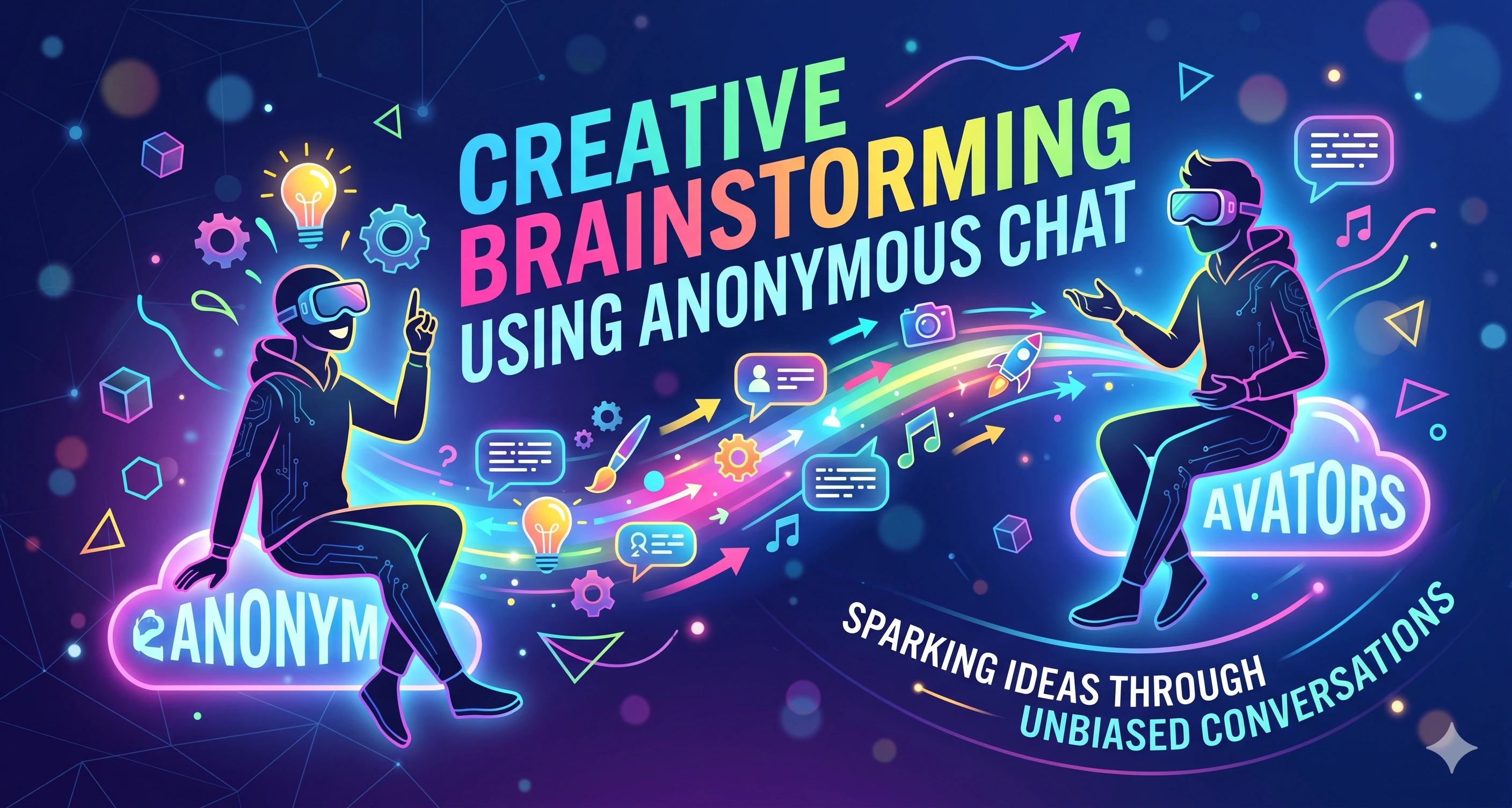
This is exactly where an anonymous chat becomes a bizarrely effective secret weapon for creatives. Think about the mechanics of it. When you completely remove your identity, your job title, your geographic location, and your social standing from the equation, you are left with absolutely nothing but your ideas.
You can throw the most absurd, unpolished concepts at the virtual wall just to see if they stick. If an idea completely bombs and the other person laughs at it? Who cares. The person on the other side of the screen doesn't know who you are, and they can't judge you in any way that affects your real, day-to-day life. This absolute, zero-stakes environment creates the ultimate breeding ground for out-of-the-box thinking. You are free to be wrong, free to be weird, and free to explore tangents that you would normally censor.
Breaking Out of the Echo Chamber
Another massive benefit of a random chat is that it forces you out of your regular, comfortable echo chamber. We naturally surround ourselves with people who think somewhat like us, work in similar industries, consume the same media, and generally share our worldview. While that’s great for a comfortable social life, it is absolutely terrible for true innovation.
By connecting with someone entirely by chance, you might end up pitching your complex sci-fi novel idea to a mechanic in Brazil, or discussing mobile app interface designs with a retired teacher in Japan. Their feedback will be completely untainted by your industry’s standard jargon or your personal biases. They will ask fundamental, unexpected questions simply because their brain is wired completely differently than yours. They see the world through a different lens, and that lens can illuminate the massive blind spots in your project.
Seamless Connection with Chatome
If you want to actually try this out, you need a platform that gets out of its own way. The last thing you want to do when inspiration strikes is spend twenty minutes filling out a profile, uploading a picture, or verifying an email address. The friction kills the creative spark.
This is the beauty of a platform like Chatome. It strips away the heavy, unnecessary bloat of modern social networks and drops you right into the middle of a conversation. Because Chatome prioritizes quick, seamless connections without the baggage of persistent profiles, you can rapidly cycle through a few different conversations in the span of a single hour.
You can log on and drop a prompt right into the text box: "I need a chaotic, slightly threatening name for a fictional tech company in my script, go!" Within seconds, you might get a barrage of unfiltered, brilliant nonsense from someone halfway across the world. If the conversation dries up, you simply click next and drop the prompt on someone else. It is rapid-fire iteration at its finest.
Rules for Brainstorming with Strangers
So, how do you actually use this method without just getting distracted or ending up in pointless arguments? There is a bit of an art to it.
First, go in with a highly specific prompt, but maintain a completely open mind. Don’t just drop in and say "give me ideas." Treat the stranger like an improv partner and present a scenario. Ask them, "If you had to market a new type of coffee that makes you sleepy instead of awake, what would the billboard say?"
Second, embrace the chaos. Sometimes a conversation goes completely off the rails, moving away from your original prompt into entirely unrelated territory. Don't fight it. Often, that weird, tangential conversation is exactly what triggers your lightbulb moment. Let the discussion breathe.
Finally, keep it respectful and fun. Even though you are completely anonymous, there is a real, living human on the other side taking the time to engage with your thought experiment. Treat the interaction like an improvisational comedy scene—always adopt the "yes, and..." mentality to keep the momentum going.
Finding Your Next Big Idea
Creative blocks happen when we get trapped in the rigid pathways of our own minds. Breaking out of that mental prison usually requires a shock to the system, a completely unpredictable variable that forces us to look at the problem from a new angle.
The internet can be a noisy, chaotic place, but if you know how to leverage it, that noise can become a symphony of weird, wonderful ideas. The next time you feel completely stuck, stop staring at the blank page. Jump into a conversation with someone you'll never meet, drop your guard, and see where the brainstorm takes you. The best idea you've never had might just be waiting on the other side of a random connection.