It is 2:00 AM. You are lying in bed, staring at the ceiling, and your mind is racing with anxiety about your job, your relationship, or just the overwhelming weight of existing in the modern world. You pick up your phone. You could text your best friend, but you don't want to wake them up. You could post on your social media, but you don't want your coworkers or family analyzing your mental state.
So, what do you do? If you are like thousands of other people navigating the digital age, you might turn to a stranger.
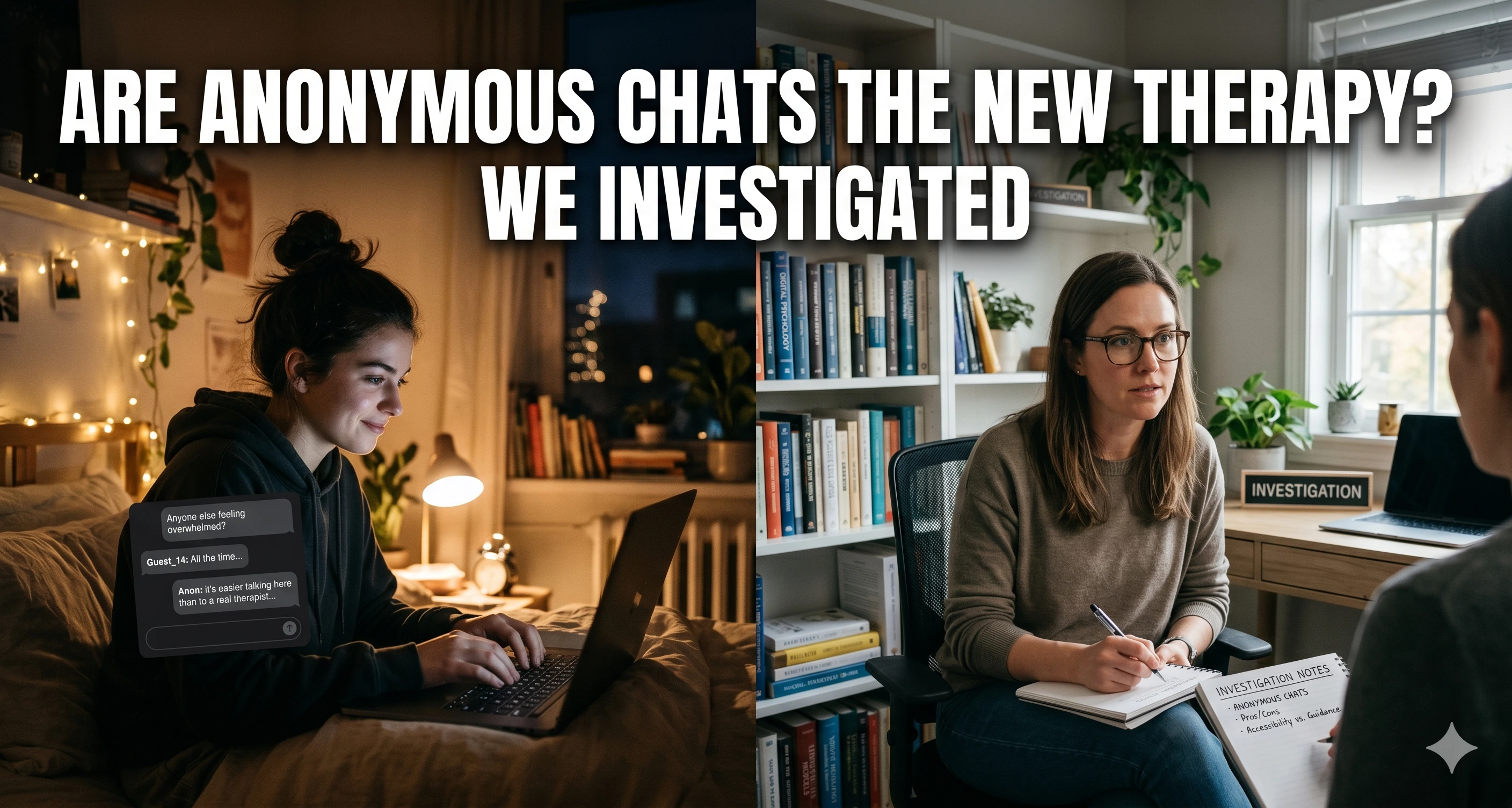
Lately, there has been a massive cultural shift in how we handle our everyday emotional baggage. Instead of booking a $150-an-hour session with a licensed professional for every minor crisis, or dumping our unfiltered thoughts onto our inner circle, people are seeking solace in the unknown. We set out to investigate a fascinating, growing phenomenon: Are these faceless, nameless interactions becoming a modern substitute for therapy?
The Heavy Burden of Being Known
To understand why talking to strangers has become so popular, we first have to look at why talking to the people we love has become so difficult.
We live in an era of highly curated identities. Every Instagram post, LinkedIn update, and even our casual group chats carry a certain expectation of who we are supposed to be. When you tell your best friend about a fight with your partner, you are acutely aware that your friend will remember this conversation the next time they see your partner. When you complain to your mom about work, you know she’ll worry.
There is a profound, exhausting weight to being known. Your friends and family have biases, historical context, and emotional investments in your life. This means that every time you confess a fear or a failure, you are also managing their reaction to it.
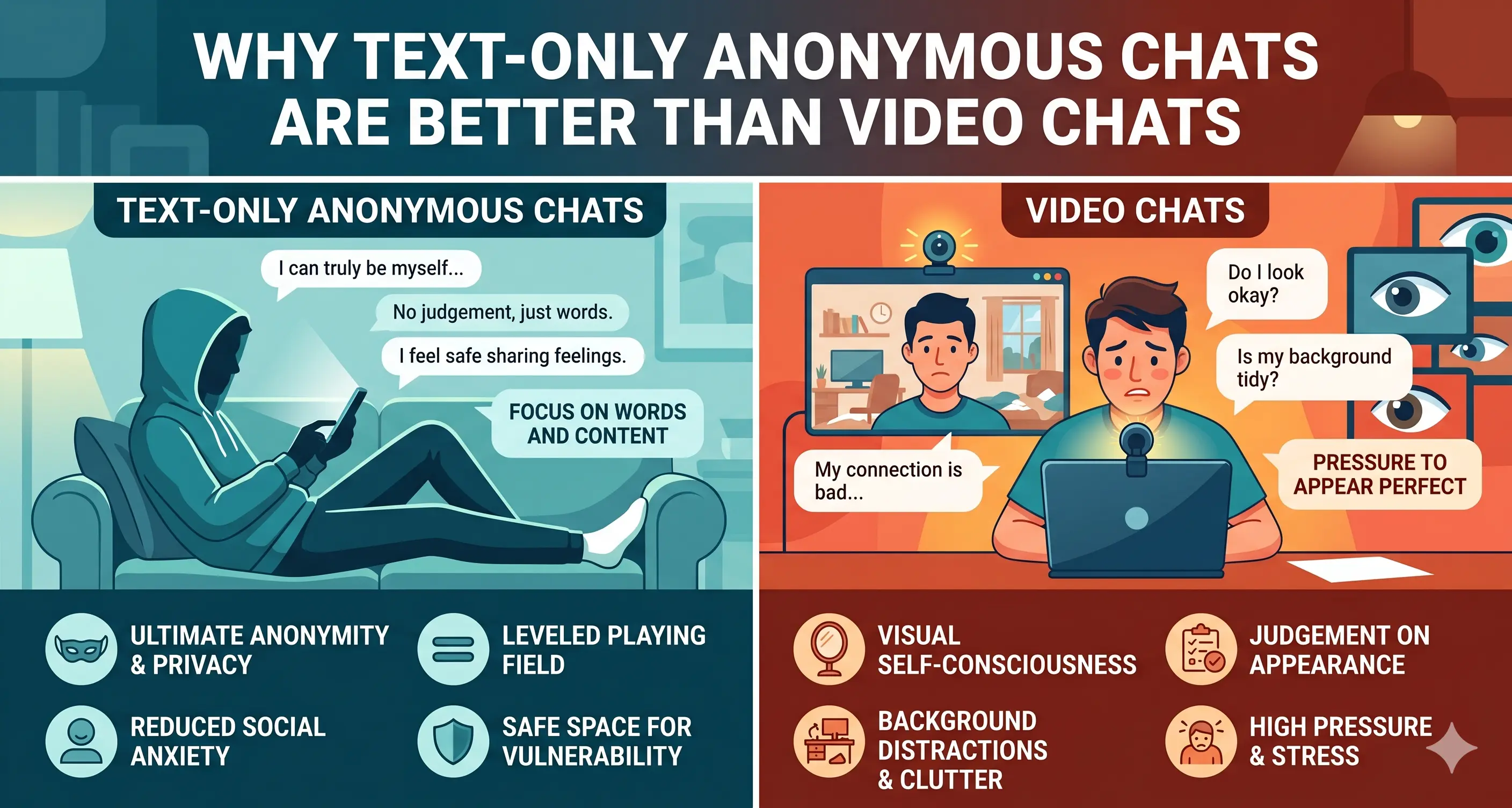
This is exactly where the anonymous chat comes in to save the day. When you strip away the names, the profile pictures, and the mutual connections, you are left with pure, unadulterated honesty. You don't have to worry about the other person judging your life choices because they don't know your life. You are a blank slate, and for a few fleeting minutes or hours, you are allowed to just be a voice in the dark.
The "Stranger on a Train" Effect
Psychologists have long known about the "Stranger on a Train" phenomenon. It refers to the surprisingly common occurrence where people reveal their deepest, darkest secrets to a complete stranger sitting next to them on a journey. Why? Because the relationship is incredibly low-stakes. You know you will likely never see this person again, which eliminates the fear of long-term judgment or social consequence.
The internet has simply taken this concept and scaled it up to a global level. Entering a random chat is the digital equivalent of sitting down next to a stranger on a cross-country train ride. You never know who you are going to get. It could be a college student in Tokyo, a retired teacher in London, or a fellow insomniac just three towns over.
There is a strange, beautiful thrill in this unpredictability. Sometimes, a random connection leads to a brief, surface-level chat about the weather or a mutual love for obscure 90s movies. But other times—more often than you might think—the conversation immediately dives into the deep end. You bypass the awkward small talk and go straight into discussing childhood traumas, existential dread, and secret hopes. The anonymity acts as a social lubricant, stripping away our natural defenses.
Finding the Right Space: The Rise of Digital Havens
Of course, not all corners of the internet are created equal. The early days of randomized chatting were notoriously chaotic, often filled with internet trolls or inappropriate content that left users feeling worse than before they logged on.
However, the landscape has evolved significantly. Today, users are gravitating toward more modernized, community-focused platforms that prioritize conversation over shock value. For instance, spaces like chathome and similar platforms have emerged as digital living rooms where people can drop in, find a listening ear, and drop out whenever they feel like it.
These platforms offer a unique kind of digital intimacy. It is a place where you can type out the words "I feel like a failure today" and watch as a little typing bubble appears from someone halfway across the world, replying with, "Me too. Let's talk about it." There is a profound sense of validation in realizing that your hyper-specific, isolating anxieties are actually a universal human experience.
The Reality Check: Is It Actually Therapy?
So, back to our main question: Can chatting with a faceless stranger replace professional therapy?
The short, responsible answer is no.
Let's be very clear about the distinction. Licensed therapists are trained professionals equipped with clinical tools to help you process trauma, manage mental health disorders, and build long-term cognitive frameworks. They track your progress over time and hold you accountable. An anonymous user named "Guest4095" cannot diagnose clinical depression, nor should they try to.
However, if we look at therapy not just as a medical treatment, but as a space for catharsis, the lines start to blur.
Not everyone who feels sad, stressed, or lonely needs a clinical intervention. Sometimes, what we really need is just to be heard without consequence. We need a release valve for the pressure cooker of daily life. In this sense, these chat platforms function as an incredible emotional stopgap. They provide instant, accessible peer support at the exact moment you need it—whether that’s during a lunch break panic attack or a midnight bout of overthinking.
Furthermore, for many people—especially those in areas where mental healthcare is prohibitively expensive or heavily stigmatized—these online chats are the only accessible outlet for emotional release. It is a stepping stone. Chatting with a stranger might just be the thing that gives someone the courage to eventually seek professional help.
The Verdict
We are more hyper-connected than any generation in human history, yet study after study shows we are experiencing an epidemic of loneliness. We are craving authentic human connection, but we are terrified of the vulnerability required to get it in our real lives.
Anonymous chats aren't replacing therapy, but they are filling a massive, aching void in our modern social fabric. They provide a safe harbor for our messy, unfiltered, and uncurated selves. They remind us that behind every screen is another complex human being who is probably just as confused, scared, and hopeful as we are.
So the next time you find yourself staring at the ceiling at 2:00 AM, maybe logging on and saying hello to a stranger isn't such a bad idea after all. You might not find a cure for all your problems, but you will almost certainly find proof that you aren't alone in them.