If you had asked tech forecasters a decade ago what the future of communication looked like, they probably would have painted a picture of hyper-realistic holograms and virtual reality boardrooms. And sure, we have some of that today in 2026. But a funny thing happened on the way to the ultimate connected utopia: we actually started craving less connection—or rather, a very different kind of it.
Despite having social media profiles that map out our entire lives, careers, and friend groups, millions of people are actively choosing to hide their faces, drop their real names, and dive into the unpredictable waters of anonymous chat apps.
It sounds counterintuitive, right? In an era where building a "personal brand" is pushed down our throats, why are so many of us looking for ways to be a nobody?
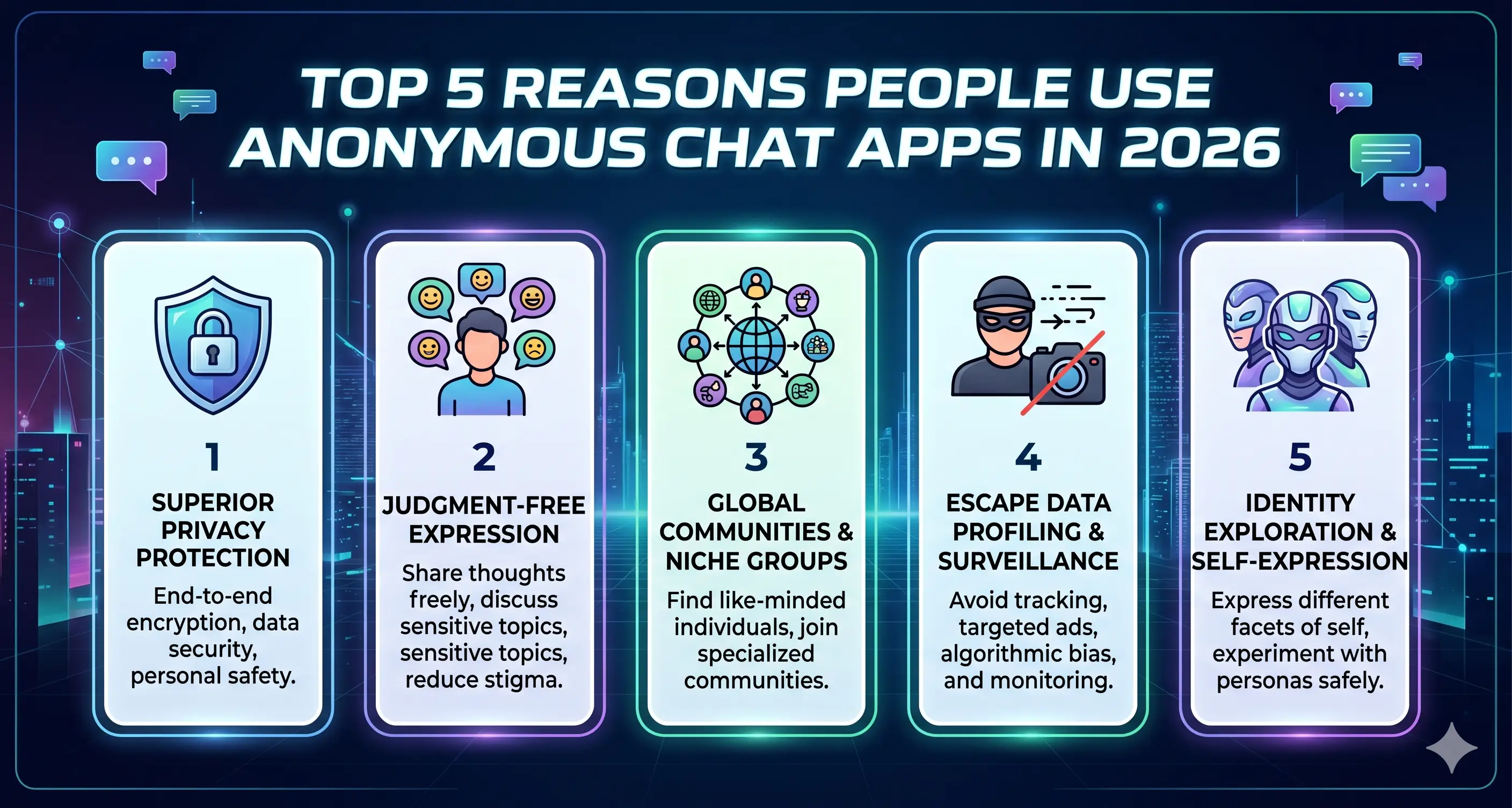
The resurgence of the random chat phenomenon isn't just a nostalgic callback to the early days of the internet. It is a direct response to the specific pressures of our modern digital landscape. Here are the top five reasons why people are flocking to anonymous chat platforms in 2026.
1. The Exhaustion of the "Curated Self"
Let’s be honest: maintaining a social media presence is exhausting. Every picture is filtered, every witty comment is overthought, and every opinion is carefully weighed against how our friends, family, or employers might react. The internet has become a stage, and we are constantly performing.
Anonymous chat apps offer a much-needed backstage area. When you strip away the profile picture, the follower count, and the bio, you are left with just your thoughts and words. People are using these platforms to experience the sheer relief of uncurated authenticity. You can be grumpy, you can be silly, you can talk about your weird niche hobbies—all without the fear of it ruining your carefully crafted digital aesthetic. It is a space where you don't have to be the "best version" of yourself; you just get to be you.
2. Escaping the Algorithmic Echo Chamber
We all know by now how the algorithms work. You click on one video about baking sourdough, and suddenly your entire feed is nothing but flour, water, and yeast. Social media feeds us exactly what we already like, surrounding us with people who share our exact political views, tastes, and demographics. It is comfortable, but it is incredibly isolating.
Engaging in a random chat is the perfect antidote to the algorithm. When you tap that "connect" button, you have absolutely no idea who will be on the other end. It could be a retired teacher in Kyoto, a college student in Nairobi, or a night-shift nurse two towns over. People use these platforms to burst their own bubbles. The thrill of talking to someone whose life experiences are entirely alien to your own is a fantastic way to regain perspective and remember how diverse the world actually is.
3. Finding a Safe Space to Confess and Vent
Sometimes, the people closest to us are the hardest ones to talk to. If you are struggling with a relationship issue, feeling overwhelmed by a career choice, or dealing with mental health hurdles, bringing it up to friends and family carries the heavy weight of judgment or unwanted sympathy.
Because of this, many internet users are turning anonymous platforms into their own personal, modern-day confessionals. It is surprisingly liberating to spill your deepest secrets to a complete stranger. They don't know your history, they have no vested interest in your life choices, and they can offer objective advice. For many, finding a comfortable chathome—a reliable, anonymous community where they feel heard without being identified—has become a vital part of their mental wellness routine. It’s a safe haven where vulnerability isn't punished by real-world consequences.
4. The Pure Thrill of Spontaneity
In 2026, our lives are scheduled down to the minute. Our calendars sync across devices, our smartwatches tell us when to stand up, and AI predicts what we want for dinner before we even open the fridge. Everything is optimized, predictable, and, quite frankly, a little boring.
Anonymous chatting injects a much-needed dose of chaos and spontaneity into our hyper-organized lives. There is a gamified thrill to it—the digital equivalent of a slot machine, but for human connection. Will the next person be hilarious? Will they share a profound piece of life advice? Or will it just be a brief, pleasant exchange about the weather before you both disconnect and disappear into the ether forever? That unpredictability is magnetic. It’s the digital equivalent of striking up a conversation with a stranger at a bus stop, without having to actually leave your living room.
5. Heightened Paranoia Over Privacy and Digital Footprints
You can't talk about internet trends in 2026 without addressing the elephant in the room: data privacy. With AI scraping our data to train models, and corporations tracking our every click to sell targeted ads, people are more protective of their digital footprints than ever before.
We are painfully aware that anything posted under our real names lives forever. Anonymous chat provides a way to converse, debate, and socialize without feeding the corporate data machine. Users appreciate platforms that promise ephemeral conversations—chats that disappear the moment the window is closed, leaving no trace, no saved logs, and no data trail to be packaged and sold. It is a quiet rebellion against the surveillance economy. By remaining nameless, users reclaim a small piece of their digital sovereignty.
The Bottom Line
While the technology powering the internet continues to grow more complex, human nature remains pretty simple. We want to be heard, we want to connect, and we want to feel safe while doing it. In 2026, anonymous chat apps aren't just for bored teenagers; they are a vital tool for adults seeking genuine, unfiltered interaction in a world that often feels entirely too plastic.