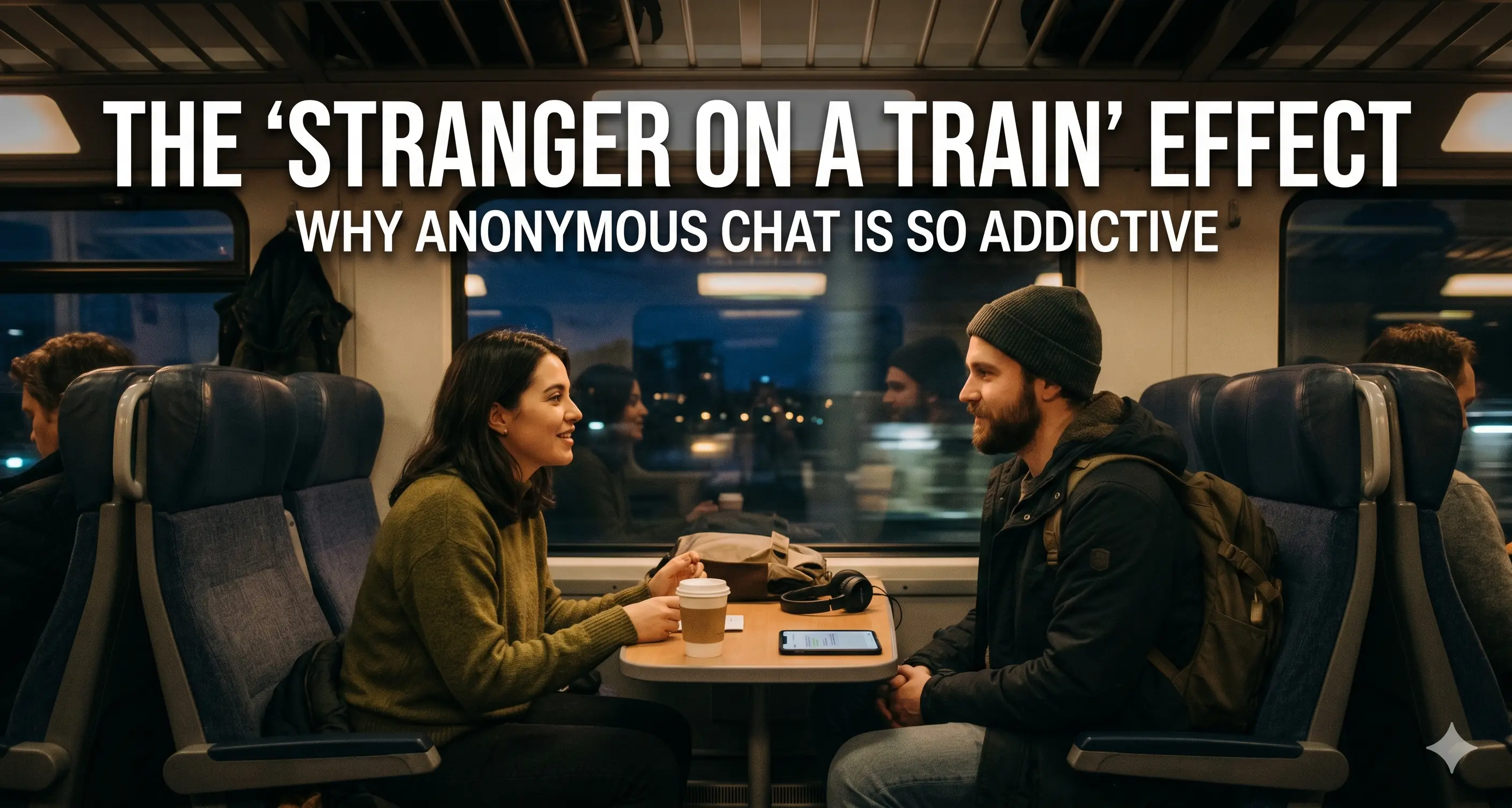
Have you ever found yourself sitting next to a complete stranger on a long train ride, bus journey, or flight, only to realize hours later that you have just shared your deepest secrets with someone whose last name you do not even know? You told them about your career anxieties, your relationship struggles, or your childhood dreams—things you have never even confessed to your closest friends or family members. Then, the train arrives at the station, you both say your goodbyes, part ways, and likely never see each other again.
This curious, fleeting, yet profound intimacy is known in psychology as the "Stranger on a Train" phenomenon. For decades, sociologists and psychologists have been fascinated by this paradox: why do we often feel more comfortable sharing our most vulnerable selves with people we have absolutely no connection to?
Today, this psychological phenomenon has entirely migrated from physical railway cars to the digital realm. The modern equivalent of the seatmate is the anonymous online user. High-performance anonymous chat platforms, like Chatome, are engineered to replicate this exact social dynamic on a massive, global scale. But what is the science behind this? Why does talking to a faceless stranger over the internet feel so incredibly liberating, and more importantly, why is the experience of anonymous chatting so undeniably addictive?
The Psychology Behind the 'Stranger on a Train'
To understand the digital addiction to anonymous chatting, we must first unpack the foundational psychology of the "Stranger on a Train" effect. Coined and studied extensively by psychologists like Zick Rubin in the 1970s, this concept revolves around the mechanics of self-disclosure and social risk.
In our everyday lives, our relationships are governed by the Social Penetration Theory, proposed by Irwin Altman and Dalmas Taylor. This theory compares the human personality to an onion, consisting of multiple layers. When we meet someone in our daily lives—like a new coworker or a neighbor—we engage in a slow, calculated process of peeling back these layers. We start with small talk (the breadth of disclosure) and very slowly move toward intimate, personal topics (the depth of disclosure). We are cautious because opening up carries a significant amount of social risk. If you tell a friend a secret, there is a possibility of judgment, gossip, or a fundamental change in your ongoing relationship dynamic.
The "Stranger on a Train" bypasses this entire process. Because both parties subconsciously recognize that the interaction is temporary and carries zero long-term consequences, the perceived social risk drops to absolute zero. You do not share a social circle, a workplace, or a neighborhood. This creates a unique psychological safety net. It allows individuals to instantly bypass the superficial "small talk" layers and dive straight into the core of the metaphorical onion. You can test out new ideas, vent frustrations, or confess guilt without the fear of your words coming back to haunt your daily life.
The Digital Transition: From Railway Cars to Anonymous Platforms
With the advent of the internet and mobile applications, the "Stranger on a Train" effect was supercharged. You no longer have to wait for a long commute to experience this liberating form of communication. Today, a global network of strangers is available in your pocket 24/7.
Modern anonymous chat platforms take the core elements of the train scenario—anonymity, lack of real-world consequences, and novelty—and gamify them. When a user logs into a platform, they are instantly connected with someone from across the globe. The geographical and cultural barriers are instantly shattered. You could be a student in London chatting with a developer in Jakarta. This globalization of the "stranger" adds a layer of intense novelty to the experience.
Furthermore, the technological infrastructure behind these platforms plays a massive role in their psychological appeal. Fast server response times, seamless file sharing, and optimized data delivery ensure that the conversation flows as naturally as if you were sitting face-to-face. When platforms optimize their performance—such as migrating from clunky base64 image processing to efficient direct file uploads—they remove technical friction. This ensures that the psychological immersion of the chat is never broken by lag or loading screens, keeping the user entirely engaged in the moment.
The Psychology of Addiction: Why We Can't Stop Chatting
The transition from a one-off train ride to an app on your phone introduces the element of addiction. Why do users spend hours endlessly connecting, disconnecting, and reconnecting with strangers? The answer lies in a potent mix of neurology and digital behavioral psychology.
1. The Dopamine Loop of Unpredictable Rewards
At the core of anonymous chat addiction is the brain's dopamine system. Social media platforms already hijack this system through likes and notifications, but anonymous chat operates on a more primal mechanism known as the "variable ratio reinforcement schedule." This is the same psychological principle that makes slot machines so addictive.
When you click "next" or "connect" on an anonymous chat application, you have absolutely no idea who you are going to meet. You might connect with a troll, someone who instantly disconnects, or you might find a profound, hour-long conversation with a kindred spirit. Because the reward (a great conversation) is unpredictable in its timing and frequency, your brain constantly releases dopamine in anticipation of the next connection. The thrill of the unknown keeps users clicking the "next" button long into the night.
2. The Online Disinhibition Effect
In 2004, psychologist John Suler introduced the concept of the "Online Disinhibition Effect" to explain why people act differently on the internet than they do in person. Suler identified "dissociative anonymity" as a primary driver. In an anonymous chat, your physical identity, your past, and your insecurities are left behind. You become a blank slate.
This lack of eye contact and physical presence creates a massive reduction in social anxiety. For individuals who feel shy, judged, or constrained by their real-world identities, the anonymous chat room becomes a playground of self-expression. They can try on new personas, be more assertive, or be more emotionally open than they ever could be offline. This newfound freedom is incredibly intoxicating and draws users back repeatedly.
3. The Ultimate Emotional Catharsis
Humans have a fundamental need to be heard and validated. However, our real-world support systems are sometimes inadequate. We may feel burdensome to our friends, or we may be dealing with issues we are too ashamed to discuss with our family. Anonymous chat provides a form of instant emotional catharsis. It is a digital confessional. The ability to articulate your deepest worries to a completely unbiased listener, receive sympathetic advice from a stranger on the other side of the world, and then disappear back into the digital ether provides a massive sense of psychological relief.
The Dual Motivations: Self-Expression vs. Toxic Behavior
It is important to acknowledge that the addictive nature of anonymous chat platforms has a dual nature. Recent psychological studies, such as those conducted at the University of Queensland, have shown that people seek online anonymity for two vastly different primary reasons: pure self-expression or toxic behavior.
For the majority of users, anonymity is a tool for connection. Socially anxious individuals use these platforms to build communication skills in a low-stakes environment. They seek "consequential strangers"—people outside their immediate circle who can offer fresh perspectives, diverse cultural insights, and empathy. For these users, the addiction is to the feeling of belonging and understanding.
Conversely, the exact same anonymity that fosters deep intimacy can also foster toxicity. The removal of consequences and accountability can amplify anti-social behaviors like trolling or bullying. The "keyboard warrior" phenomenon is driven by the fact that the stranger on the screen does not feel like a real person with real emotions. Managing this dichotomy is the ultimate challenge for developers of modern anonymous chat platforms. The goal is to cultivate an environment that maximizes the positive "Stranger on a Train" effect while mitigating the negative aspects of the Online Disinhibition Effect.
The Future of Digital Intimacy
As technology continues to evolve, the ways in which we experience the "Stranger on a Train" effect will only become more sophisticated. The integration of artificial intelligence and advanced matchmaking algorithms into anonymous chat ecosystems is already beginning to reshape the landscape. Imagine an anonymous platform that uses natural language processing to instantly pair you with a stranger who is experiencing the exact same life challenges as you, or one that features intelligent, concise AI personas that can help guide a conversation when it stalls.
The human desire for connection is innate and unyielding. As long as there are people who feel isolated in their physical lives, there will be a profound demand for the digital seatmate. Anonymous chat platforms provide a unique, highly addictive cocktail of psychological safety, absolute freedom, and unpredictable reward. They remind us that sometimes, the most profound thing we can do is reach out into the dark, simply to hear a voice whisper back, "I understand."
In a world that is increasingly hyper-connected yet paradoxically lonely, the digital stranger offers a brief, beautiful window into the shared human experience. And that is a journey we are all eager to take again and again.