The digital age has fundamentally altered how we meet people. Gone are the days when meeting a stranger required a physical location or a mutual friend. Today, we have the world at our fingertips, and one of the most intriguing phenomena in this landscape is the random chat. It is a unique digital ecosystem where anonymity meets vulnerability, and where a single "Hi" can lead to a lifelong friendship or a five-second "ghost."
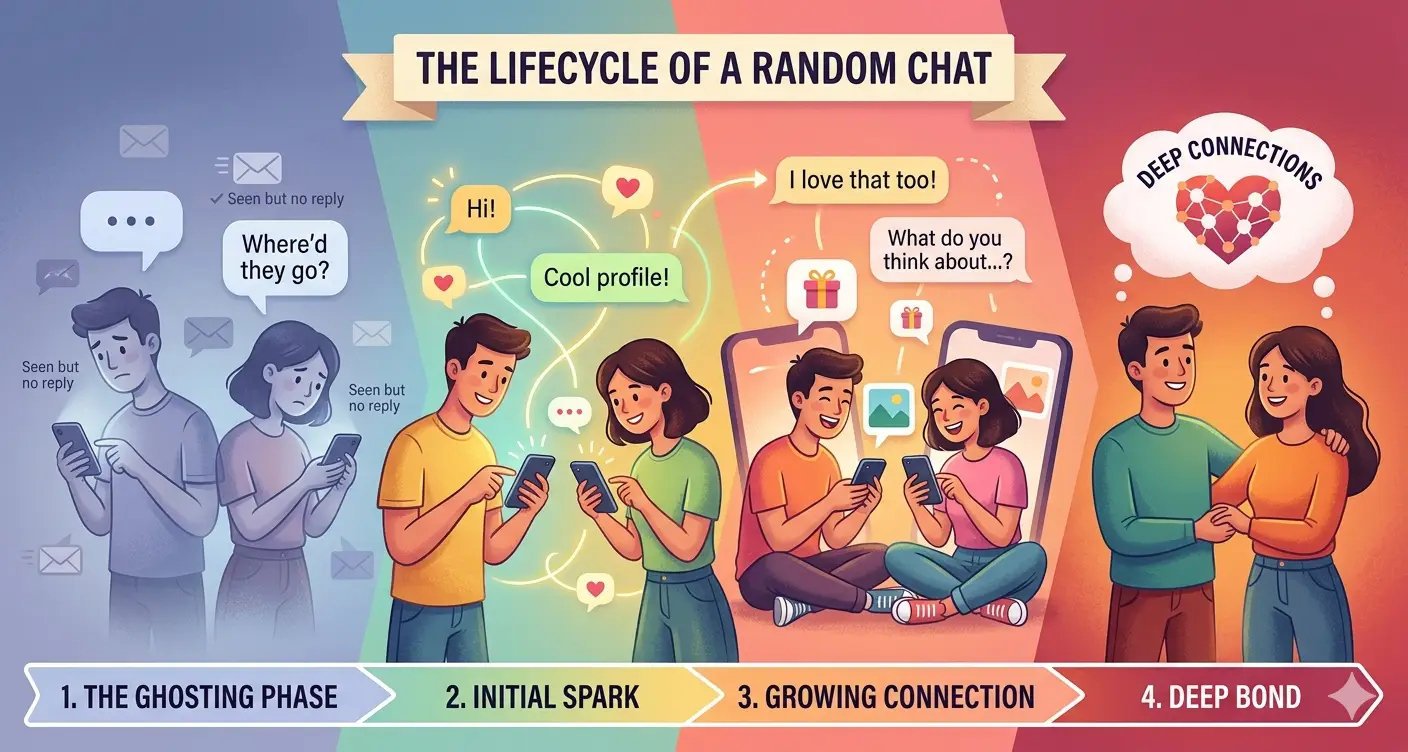
Understanding the lifecycle of a random chat is essential for anyone navigating the waters of anonymous chat platforms. Whether you are looking for a casual distraction or a meaningful conversation, here is how the journey typically unfolds.
Phase 1: The Spark of Anonymity
The journey begins with a click. On platforms like Chatome, the barrier to entry is non-existent. There’s no profile picture to curate, no bio to obsess over, and no social pressure to perform. This is the "blank slate" phase.
The appeal of a random chat lies in its unpredictability. You aren't matched based on an algorithm that knows your favorite coffee bean; you are matched simply because you and another human being are online at the same time, looking for a connection. This phase is characterized by a mix of adrenaline and curiosity. The anonymity provides a "safety net" that allows people to be more honest than they might be in their real-world social circles.
Phase 2: The "Filter" and the Art of the Greeting
This is where the lifecycle often hits its first hurdle. In the world of online chatting, the first ten seconds are critical. This is the "Filter Phase." Most users are looking for a specific vibe. If the greeting is too dry, too aggressive, or simply doesn't land, one party might skip to the next person.
Ghosting at this stage isn't personal; it’s a form of rapid-fire curation. However, for those who move past the "ASL" (Age/Sex/Location) phase and start talking about shared interests, the conversation begins to take root. The key to surviving this phase is authenticity. Instead of a generic "Hello," those who share a thought, a joke, or a question about the other person’s day tend to find more success.
Phase 3: The Deep Dive
Once the initial awkwardness fades, a random chat can move surprisingly fast. Because you are talking to a stranger you might never meet, the "Stranger on a Train" effect kicks in. People often find it easier to confess their fears, dreams, or daily frustrations to an anonymous stranger than to their closest friends.
During this stage, the anonymous chat evolves from small talk into something substantial. You might find yourself discussing philosophy, venting about a stressful job, or sharing music recommendations. This is the "sweet spot" of the lifecycle—the moment where the digital noise fades away, and it’s just two minds connecting across the void.
Phase 4: The Pivot Point
Every digital interaction eventually reaches a crossroads. After a few hours (or days) of deep conversation, the participants face a choice:
The Graceful Exit: The conversation has served its purpose, and both parties part ways, grateful for the moment but ready to move on.
The "Ghost": One party suddenly stops responding, leaving the other wondering what went wrong.
The Transition: The connection is too good to lose. This is when users decide to move the conversation to a more permanent platform or reveal their identities.
The transition is the rarest and most rewarding part of the lifecycle. It transforms a fleeting digital encounter into a tangible relationship.
Why Platforms Like Chatome Matter
In an era of highly curated social media, we are often surrounded by people we know but feel more alone than ever. Chatome and similar random chat services offer a "reset button." They remind us that human connection doesn't always need a face or a last name to be real. By stripping away the labels, these platforms allow us to focus on the core of communication: the exchange of ideas and emotions.
Conclusion: Embracing the Uncertainty
The lifecycle of a random chat is a microcosm of human relationships. It has its highs, its lows, and its sudden ends. While ghosting is an unfortunate side effect of digital anonymity, it shouldn't overshadow the potential for "deep connections."
Next time you find yourself on an anonymous chat, remember that behind the screen is another person looking for a moment of clarity, a laugh, or a deep conversation. Approach it with an open mind, stay safe, and who knows? You might just move past the "Ghosting" phase and find a connection that lasts long after the chat window closes.